
Keeping all of your natural teeth is important for a number of reasons. Most humans have 32 teeth.1 Missing teeth often make a person feel self-conscious. Missing teeth also make it harder to speak and to chew foods, especially some fruits, vegetables, nuts and meats.
As part of your digestive system, each tooth category has a unique function in breaking down foods. Incisors help you bite into food; canines help tear foods; pre-molars tear, crush and grind food; and molars play a pivotal role as your main chewing teeth.2 The more of these teeth that are missing, the harder it is to digest food properly.
That is why it is important for adults to care for the only set of natural teeth they will every have.
Tooth Structure
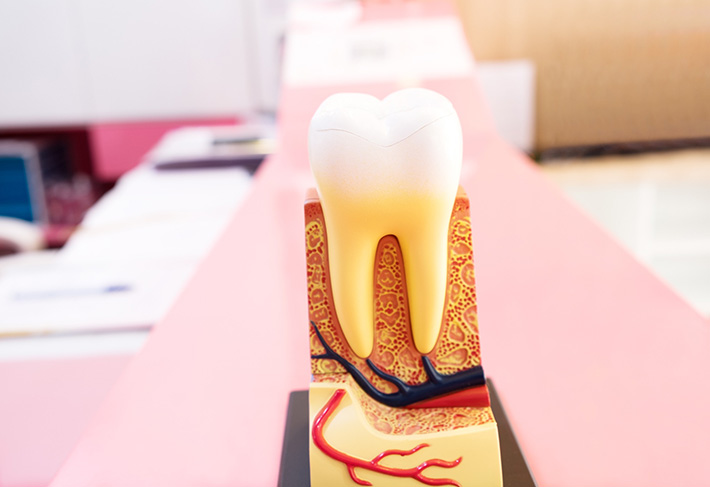
To understand how a tooth decays, it is important to understand the anatomy of a tooth. Teeth consist of two parts: the crown, which is above the gum line and the part you can see, and the root, which is below the gum line.
The outside of a tooth is coated with enamel, which is the hardest substance in the human body.3 Beneath the enamel lies a layer of dentin, which isn’t as strong as enamel. When exposed because of enamel wear, the dentin puts you at risk for cavities.
Inside the dentin lies the root of the tooth which extends into the bone and holds the tooth in place. The root makes up approximately two-thirds of the tooth.4
Tooth decay starts out when bacteria, food particles and saliva form a colorless, sticky film on your teeth called dental plaque. Dental plaque forms on everyone’s teeth every day. Brushing your teeth twice daily for two minutes each time, flossing between teeth, and using a dental rinse each day breaks down and removes dental plaque.
If a good oral hygiene routine is not followed that dental plaque builds up and hardens over time into a substance called tartar. Tartar can’t be removed by brushing or cleaning; it can only be removed by a dental hygienist or dentist.5 In addition to possibly developing gingivitis (gum disease) or receding gums, tartar causes cavities to form.
There are five stages of tooth decay.
The first is called initial demineralization.6 This process occurs when the enamel in your teeth are exposed to acids produced by plaque bacteria and those minerals in your enamel start to break down. When this happens a white spot may appear on your tooth.
The second stage is actual enamel decay, which may appear as a white spot or the entire tooth may darken to a brownish color. This is the stage when small holes form in your teeth. These holes are called cavities and they can be filled by a dentist to stop further damage to the tooth.
Stage 3 is when the decay extends to the dentin, the area below the tooth enamel. Dentin, being softer than enamel, is more prone to acid damage so tooth decay proceeds at a more rapid rate when it reaches the dentin. Because dentin has tubes connecting it to the nerves of the tooth decay may cause tooth sensitivity, particularly when hot or cold foods are consumed. That is why it is important to let your dentist know if you are experiencing tooth sensitivity.
The fourth stage is when the decay reaches the pulp, or the innermost layer of your tooth. Pain is your most common indication of decay reaching the pulp because decay causes pulp to swell and the swollen tissue has nowhere to expand, placing pressure on the nerves and creating pain.
The final stage of tooth decay is when an abscess, or pocket of pus, forms at the bottom of the tooth. Pain often radiates into the jaw, gums, or face and can be accompanied by a fever or swelling of the lymph nodes in your neck. Immediate treatment by a dentist is required if you suspect that you have an abscessed tooth.
The good news is that proper oral hygiene routines can prevent tooth decay. Brushing, flossing and using a mouth rinse on a daily basis are a good start. It is also essential to have your teeth professionally checked by a dentist and cleaned by a dental hygienist, generally every six months, to remove the tartar that can’t be removed by brushing alone.
Expert Dental Care in Walled Lake
Call Walled Lake Dentist and schedule a dental checkup today! Our dental services stand apart from other dental practices throughout the area due to our commitment to customized patient care because each patient has unique dental needs. We offer more than general dentistry, our services include cosmetic dentistry, dental treatments, children’s dentistry and more! We are looking forward to making your mouth healthy and bright so that you love to smile!
____________________________________________________
1, 2, 3Teeth
Link: https://my.clevelandclinic.org/health/body/24655-teeth
4 Tooth Anatomy by Adrienne Santos-Longhurst, 5/15/2018
Link: https://www.healthline.com/health/tooth-anatomy#structure-and-function
5 Tartar
Link: https://my.clevelandclinic.org/health/diseases/25102-tartar
6 The Stages of Tooth Decay: What They Look Like by Jill Seladi-Schulman, PhD, 7/30/2020
Link: https://www.healthline.com/health/dental-and-oral-health/tooth-decay-stages#stages-of-decay